Designed a goal system that works with OKRs, EOS or your own
Leadership asked for OKRs. Research showed no company ran one framework cleanly, so I made the case for modelling the pieces they all share, and wrote the requirements while the team had no product manager.
- Role
- Design Lead
- Product
- Slingshot
- Year
- 2025
- Team
- Two designers, product management, engineering
Under NDA, so the final designs are not on this page. I can show explorations that were set aside, along with how I worked and what I decided and why, which is the part that transfers anyway.
What Slingshot is
Slingshot is a marketing execution platform that keeps performance data and the work behind it in one workspace, for marketing teams that are accountable for revenue.
The request came with real evidence behind it
Leadership had published a methodology for how companies set and track goals, and had been teaching it in workshops with other founders. Those rooms were full of executives saying it worked. The conclusion was that our product should have a feature built around it.
That is a better starting point than most feature requests. It came from real conversations with real operators. It also arrived as a solution rather than a problem, at a moment when there was no product manager on the team and no brief beyond the name of a framework.
Everyone we talked to had their own mix
Two designers ran the discovery together. My UX partner joined the interviews, took notes, wrote the scripts and brainstormed with me. We interviewed five companies, deliberately unalike: a family run food manufacturer, a multi store retail operator, a consultant who builds strategic plans for other businesses. We ran scenario sessions with a team manager and with an individual contributor, reading them written situations and watching which ones they recognised.
Five companies is not a market study and I would not claim it was. But across those five, not one was running a single framework cleanly.
One ran EOS, with quarterly Rocks and a weekly scorecard, and had spent a year learning it. A consultant used a growth planner she had built herself, which her clients keep using because, in her words, it “just works”. One thought about goals in four tiers of his own invention, a minimum, a tactical goal, a stretch goal and a vision goal. Most were mixing pieces of several methods inside a spreadsheet.
Two lines from those interviews drove the design:
“A fixed and mandatory framework is confusing and tedious to use.”
“You need to meet people where they are at their methodology.”
OKRs were still the most clearly articulated model in the room, and the one leadership could actually teach. So the question stopped being whether to build OKRs. It became whether everything else could be expressed in the same system, without losing what OKRs make explicit.
Modelling the pieces instead of picking a framework
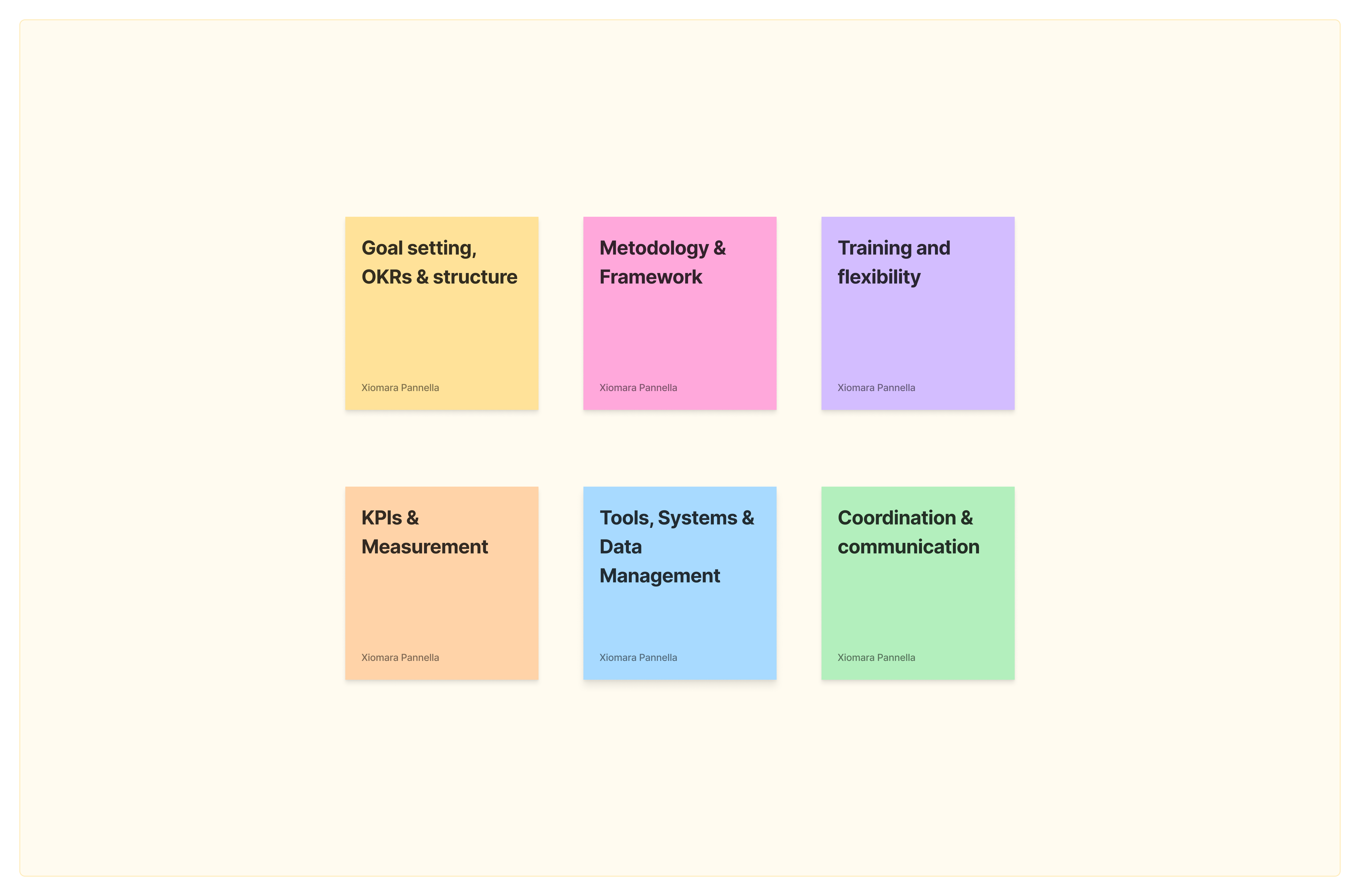
Every one of these frameworks turned out to be made of the same parts. A thing with a name. A description. A cycle. An owner. A team. A way of measuring progress. A check in. A relationship to the things above and below it.
So instead of designing OKRs, we designed those parts, and then a layer above them that combines and renames them. OKRs become one arrangement. EOS Rocks become another. A company’s own method becomes a third. The structure holds, the vocabulary changes.
We borrowed the language from design systems and called them atoms and molecules. The same idea, applied to a data model rather than to an interface.
In the product, a company starts by choosing a framework as a template. The settings underneath can all be changed, so adjusting a template far enough gives you the equivalent of another framework.
Then we stress tested it. If the model was right, every goal in any framework should fall into one of four shapes: reach for something aspirational, move a metric, finish something, or try something and learn.
EOS Rocks landed mostly in finish something and move a metric. OKRs could be any of the four, depending on how they were written. The model held.
One progress bar cannot mean six things
Once goals stop being one shape, measuring them stops being one thing.
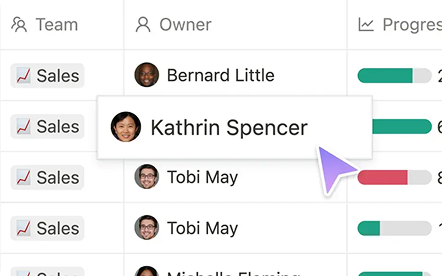
A key result that says “deliver 3,800 leads a month” moves a number. An initiative that says “hire three people” is done or it is not. A goal that says “maintain a minimum close ratio of 18%” is not trying to go anywhere, it is trying to stay put.
In an early version of the table, that last one showed as zero percent complete and not started. A goal you are successfully holding steady should not look like a goal nobody has touched.
So progress became a decision rather than a single bar. Reach a metric, finish a set of activities, or simply open and done, each with its own source and its own way of being shown.
Our product architect raised the same point from the other direction, asking whether a field called measuring progress even applies when the type is an objective rather than a key result. He was right, and the answer shaped the creation form.
Data visualization, the hardest part of the interface, was my UX partner’s area. I ran the benchmarking, the flows and the work with stakeholders.
Selling a bigger answer than the one that was asked for
The uncomfortable part of this project was not the design. The research pointed somewhere other than the brief, and the brief belonged to the person who would approve the work.
My note to myself before that meeting:
“At first sight we just wanted OKRs, are we complicating? Explain that reality out there by talking with CEOs and looking to competitors. We cannot force people into a rigid set. We offer flexibility but guidance.”
The plan was to lead with the evidence rather than the design, name the over engineering objection before anyone else could, and show one flow rather than a whole system, so the conversation stayed about the idea instead of the pixels.
The ending is better than being right. Leadership’s own methodology went into the design as one of the templates, next to OKRs and SMART goals. Anyone who already used it would keep it. Everyone else could bring what they had.
Talking to engineering before showing them anything
I did the same thing in reverse with the engineering team. Before any design went in front of them, I walked through what competitors were doing with progress measurement, from the simplest case to the most complex, and asked what was feasible from their side.
Showing a design first turns the conversation into a yes or no about that design. Showing the problem first turns it into a conversation about what is possible, and it meant we did not spend weeks going back and forth over something that was never going to be built.
Working without a product manager, and then with one
For the first stretch there was no product manager, so I was writing requirements as well as designing. Deciding what was in and out of scope, keeping track of what had been agreed, presenting plans and milestones to leadership directly.
When our product manager returned from leave, a lot had already been decided. Some of those requirements were reworked once she was in the room, and that cost us time.
The problem was not that I made those calls. Someone had to. It was that I kept too much of the reasoning in conversations and in my own head, instead of writing it down in a form someone else could pick up and carry. A decision that only exists in the person who made it is not really a decision yet.
What I would do differently
User testing was on the plan and never happened. We validated scenarios with a manager and an individual contributor during discovery, which is how we found that one of our four scenarios did not survive contact with a real person. We never put the built flows in front of anyone.
For a system whose whole premise is that it adapts to how you already work, that is the gap I would close first. The model was sound on paper. Whether someone picks the right template on their first day, without us explaining it, is the question we never got to answer.
